Car Purchase Criteria 2025 – What Do the Data from Germany and the UK Reveal About the Finnish Market?

The decision-making process for buying a car appears surprisingly similar across European markets. Recent data from Statista regarding Germany and the United Kingdom shows that the basic logic of buyers has not changed radically – however, there are differences in emphasis, from which Finnish automotive professionals can learn.
Although Finland is neither Germany nor the United Kingdom, we find ourselves in many ways between these two markets. That’s precisely why comparing them offers valuable signals about the direction Finnish purchasing behaviour is heading.
In this article, I will discuss three key findings and, most importantly, what they mean for the Finnish market in practice.
Safety and everyday practicality are indisputable cornerstones in Finland
Both in Germany and the United Kingdom, safety (53%) and everyday usability (47%) are clearly the most important car purchasing criteria. This is even more pronounced in Finland.
The Finnish buyer evaluates a car primarily through the lens of their everyday life, not based on individual features. Safety and usability are not competitive advantages; they are foundational elements, from which people are rarely willing to compromise.
In Finland, these criteria are particularly reinforced by:
Winter conditions that demand grip, visibility, and driving reliability.
The needs of families with children, such as the easy installation of child seats and sufficient rear seat space.
Ease of use in a busy life, for example, effortless entry and a clear user interface.
A spacious boot and good seating height, which improve ergonomics and practicality.
What does this mean for Finnish dealers and importers?
Safety, space, and usability should always be brought up early in the conversation, not as additional arguments later on. They work best through concrete examples:
How easily can a car seat be secured?
How does the car perform in slushy conditions and in the dark?
This is also reflected in online content: consider building a specific section in product cards such as “Key benefits for Finnish conditions”.
Fuel efficiency and operating costs – The UK leads the way which Finland follows
In the UK, fuel efficiency is almost as important a purchasing criterion as safety (55%). In Germany, the emphasis is slightly less (40%), but the UK market provides an interesting preview for Finland as well.
Several structural factors explain the strengthening of cost-conscious thinking in Finland:
the strong fluctuation in electricity and fuel prices
long commutes, particularly in Central and Northern Finland
the growing demands of corporate clients for predictable costs.
Simultaneously, consumer thinking has shifted. Purchase decisions are made less on litre prices and more on monthly costs.
In many ways, Finland is moving towards British buying behaviour.
What does this mean in practice?
In sales discussions, €/month thinking becomes prominent, rather than the pure purchase price.
Consider adding clear calculators to digital services: “How much do you save by switching from petrol to hybrid or electric?”
In fleet and corporate sales, TCO models (Total Cost of Ownership) are no longer a nice-to-have, but a basic necessity.
Drivetrains and electrification – Finland combines the logic of Germany and the UK
In Germany, the type of transmission is a significantly more important purchasing criterion (27%) than in the UK (15%). In Finland, the situation lies between these two.
The Finnish buyer does not make powertrain choices ideologically, but practically. The decision is typically guided by a combination of three factors:
technical sensibility and actual range in Finnish conditions
predictability of monthly costs, especially in financing and leasing models
charging possibilities at home and work, which often determine the choice more than the brand.
In practice, the Finnish buyer summarizes their choice in three questions:
Does this car suit my driving profile and daily life?
How much does it cost me per month as a whole?
Is this a technically reliable and sensible choice for Finnish conditions?
How should drivetrains be communicated in Finland?
a clear, visual presentation: “which powertrain suits which usage profile”
avoid EV vs. ICE dichotomy, instead emphasize sensible choices
Use practical scenarios as the basis for discussion:
150 km daily commute
No charging facility at home
300 km cottage trip – how does an electric car perform?
Summary: Finland is both Germany and the UK at the same time
By reflecting the data from Germany and the UK to Finland, three clear conclusions emerge:
Safety and everyday practicality are hygiene factors for Finnish buyers, not differentiators.
Cost-oriented thinking is rapidly strengthening, as in the UK – €/month is decisive.
The Finnish buyer is technically savvy, like in Germany – the sensibility of the powertrain and range are critical.
This combination makes Finland a demanding market, but simultaneously offers a clear direction.
The real competitive edge for automotive actors comes from how well they can combine safety, cost management, and technically sensible solutions for Finnish conditions.
If these are genuinely visible in the showroom, online content, and the way sellers conduct conversations, data turns into a competitive advantage, not just another report among many.
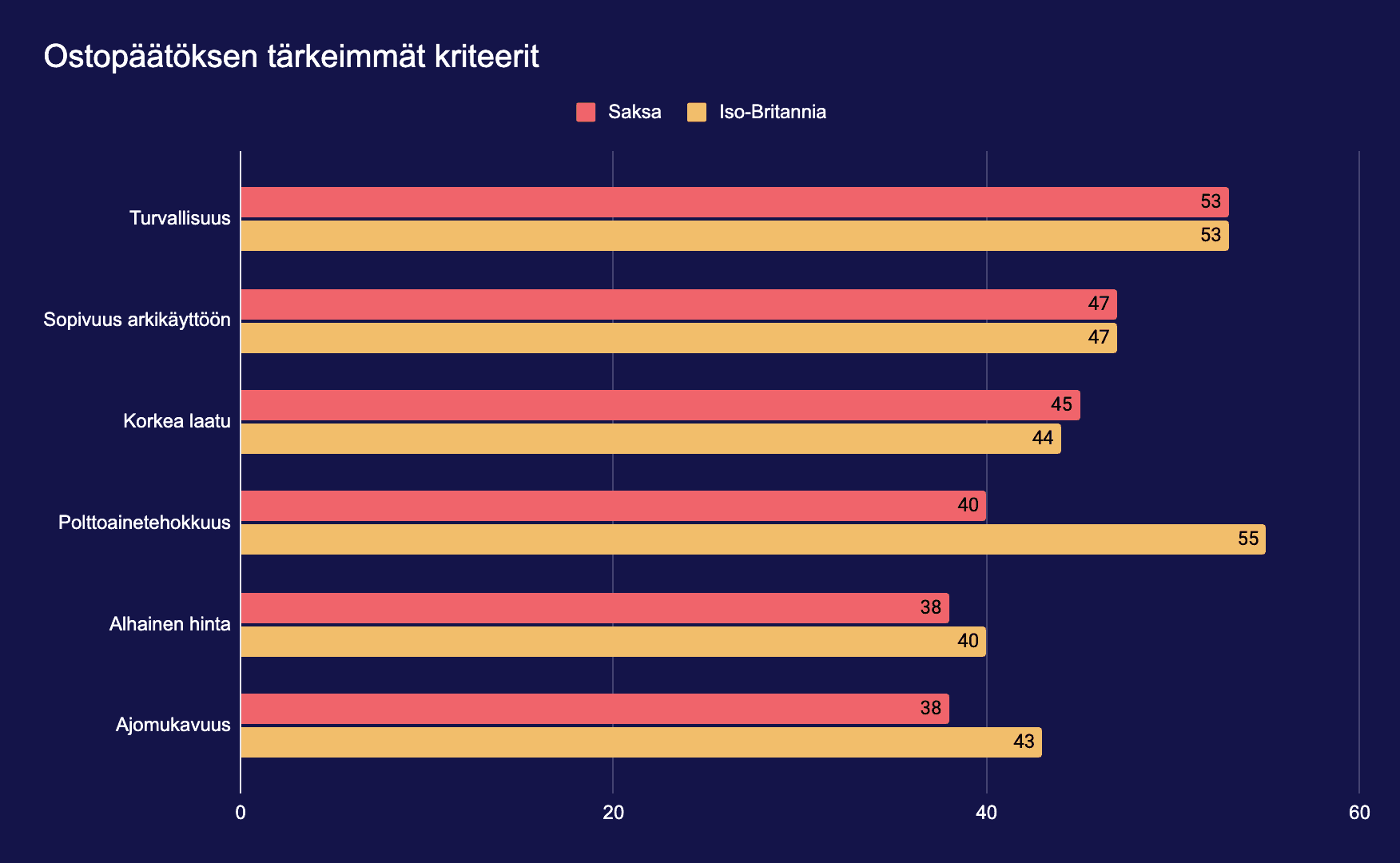
Key criteria influencing purchase decisions
This graph compares the most popular reasons for choosing a car. It clearly illustrates how safety and suitability for everyday use are universal values in both countries, but fuel efficiency is significantly more emphasized in Britain.
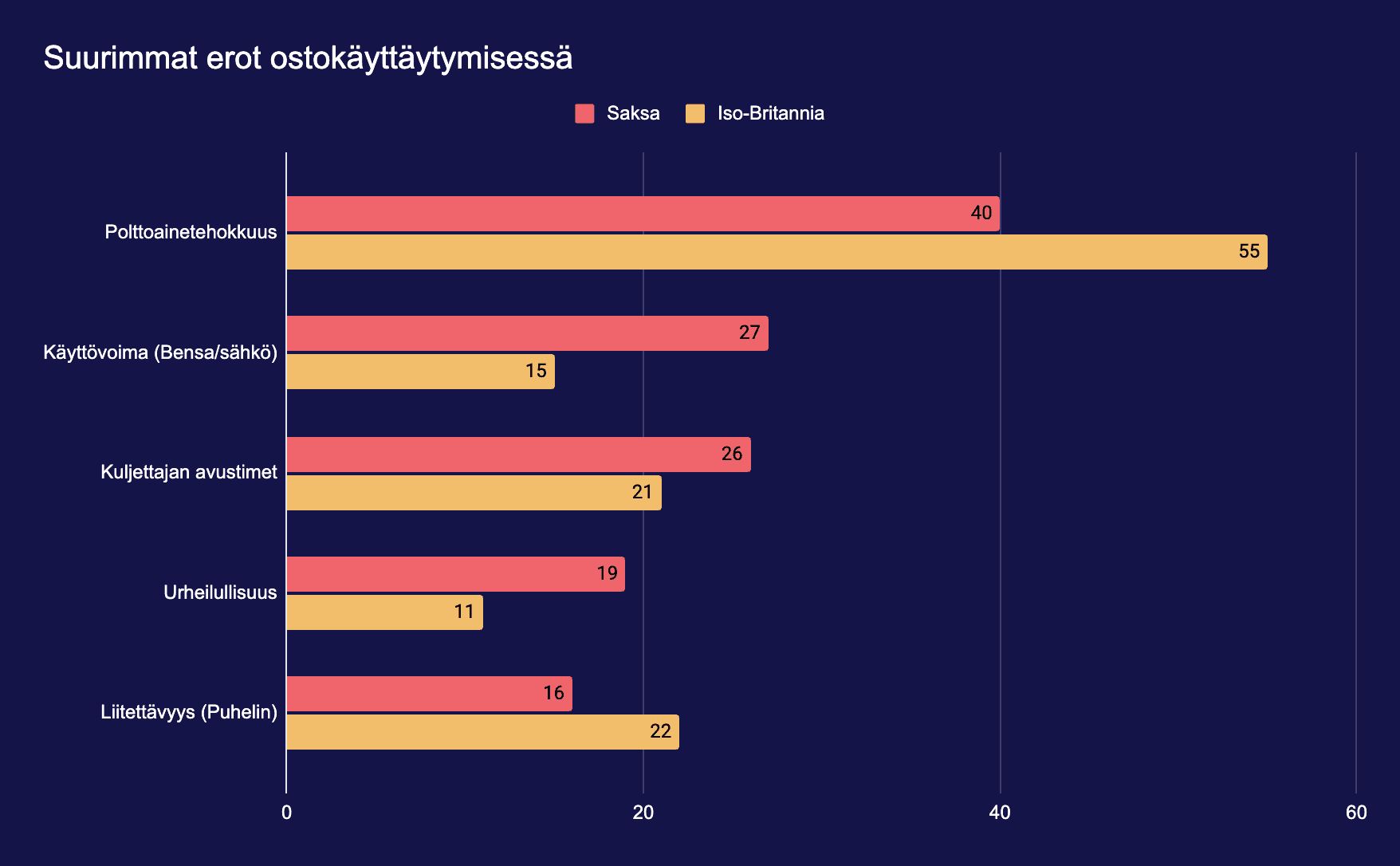
The biggest differences between countries
This graph highlights the most interesting discrepancies. It clearly shows that Germans value driving characteristics (power source, sportiness) more, whereas the British focus on economy and technological connectivity.

Patrik Parviainen
Account Manager