What is the Universal Commerce Protocol?
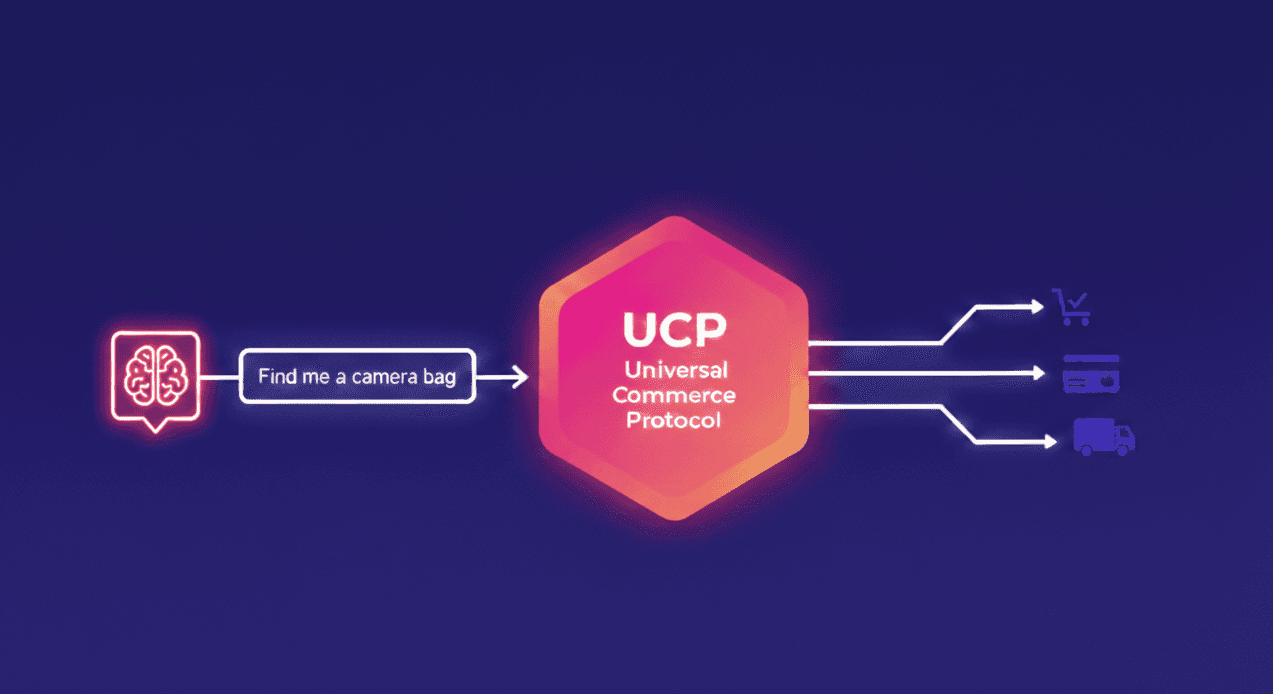
Universal Commerce Protocol: Opening the Future of AI-Assisted E-commerce
In January 2026, major e-commerce, retail, and technology players unveiled the Universal Commerce Protocol (UCP) standard, promising to revolutionise the synergy between e-commerce and AI agents. Among the giants involved in its development are Google, Shopify, Target, Etsy, Walmart, and numerous others.
What Does This Mean for Finnish E-commerce?
The Universal Commerce Protocol is an open standard that creates a common language between AI assistants and e-commerce platforms. In practice, UCP enables consumers in the future to make purchases directly through an AI assistant – such as Google's Gemini – without the need to navigate to the e-commerce website.
Imagine the scenario: a customer asks their AI assistant, "Find me a lightweight suitcase for my upcoming trip." Instead of merely listing options and links, the assistant can, with the help of UCP, display real-time stock information, prices, and potential discounts – ultimately handling the entire purchasing process from start to finish on behalf of the customer.
Why is the Universal Commerce Protocol Significant Right Now?
The traditional e-commerce infrastructure is built on the assumption that the customer navigates the e-commerce site themselves (or a similar sales channel with a graphical user interface). With the rise of AI assistants, this model is undergoing change. Consumers increasingly expect seamless experiences, where exploration transitions into purchasing decisions naturally during conversations.
For e-commerce operators, this has previously meant integration headaches: each new sales channel and platform required its own customised implementation. Modern cloud platforms, like Shopify, have streamlined the sales channel approach earlier, but UCP seeks to solve this issue by providing a standardised interface through which e-commerce can serve multiple AI platforms.
What Benefits Does UCP Offer to E-commerce Operators?
One Integration, Many Channels
Instead of building separate connections to each AI platform, UCP allows for a single integration that works with all UCP-compatible platforms. This significantly reduces development work and maintenance costs.Merchant Retains Control
Unlike in many marketplace models, with UCP the e-commerce operator remains in the "Merchant of Record" role. This means you control business logic, pricing, and customer relationships – not handing them over to the platform.Flexible Checkout Experience
UCP also supports a model where the initial part of the purchase process is handled in an AI tool, but you can still retain a fully customised checkout process. The customer experience remains on-brand, even if the purchasing path begins with an AI assistant.Open Payment System Architecture
UCP separates payment methods from payment processors, enabling a wide range of payment options – including Google Pay, cards, and other established alternatives.
What Should Finnish E-commerce Operators Do Next? Will Everything Change Immediately?
Although UCP is in its early stages, Finnish e-commerce operators should closely monitor the development:
In the Short Term (1–2 years):
Monitor how major e-commerce platforms (Shopify, WooCommerce, Adobe Commerce) integrate UCP support – be early to participate
Assess your current e-commerce platform's ability to adapt to new standards and discuss UCP support with your provider
In the Medium Term (2–4 years):
Prepare for AI-assisted purchasing to become more common in Finland as well
Consider how your product information and API interfaces are ready to serve agent-based purchasing experiences
In the Long Term:
UCP or a similar standard could transform the e-commerce playing field as significantly as mobile commerce once did. Much also depends on the direction AI assistants develop. It is also possible that UCP will face competing standards or solutions in the field.
In Conclusion
The Universal Commerce Protocol represents a significant step towards the future of AI-assisted commerce. Although the technology is still in its early stages, it is being developed by such major players that the eventual outcome will inevitably transform the e-commerce landscape.
E-commerce operators should keep UCP on their radar – not necessarily as an immediate action, but as a strategic factor that could determine competitiveness in the coming years. Those e-commerce operators with well-organised product information, flexible interfaces, and a readiness to experiment with new channels are in the best position to capitalise on the opportunities AI commerce offers.

Samuli Hokkanen
CEO