What is Specifications Driven Development (SDD)?
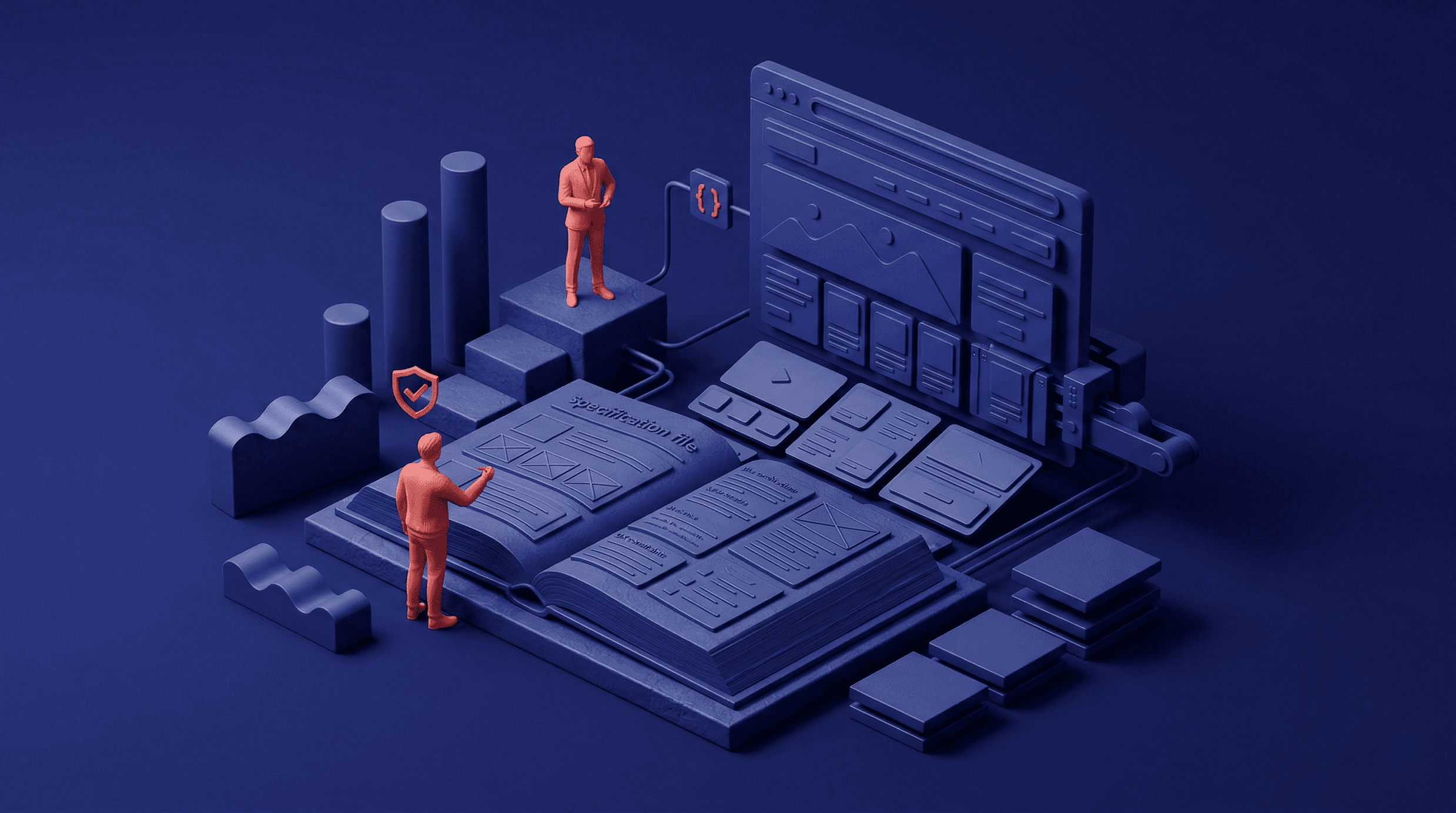
AI-assisted development tools are already part of everyday work in many teams. But the faster agents carry out software development, the clearer one challenge becomes: without guidance, AI makes assumptions, heads in the wrong direction and produces code that is difficult to maintain. Specifications Driven Development (SDD) is the answer to this problem.
What is Specifications Driven Development?
SDD is a software development approach in which specifications and documentation are used to guide the work of AI agents.
In traditional development, code is written first and documentation is attempted afterwards, if at all. SDD reverses this order: first, an exact description is written of what is being built, why, and under what constraints.
Specifications are, in practice, markdown files that live in version control alongside the code. They describe the requirements, architecture, interfaces and constraints. When the software needs to change, the specification is changed first. The code follows.
How does the SDD process work in practice?
A typical workflow proceeds in five stages:
Specification writing: The team or an individual developer records the requirements as a clear written description: what is being built, for whom and under what constraints.
Planning: The AI agent analyses the specification and proposes an implementation plan. This is an iterative stage — the human reviews and corrects it.
Task breakdown: The plan is broken down into concrete development tasks, all of which are linked to the specification.
Implementation: The AI carries out the tasks one by one. The developer oversees and approves.
Validation: The implementation is checked against the specification. Any drift, that is, a situation where the code has strayed from the agreed path, is identified and corrected in time.
A growing trend is the so-called self-spec: AI writes its own specification first before starting to code. The human reviews the specification, and only then does implementation begin. This way, misunderstandings are found before a single line of code has been written.
Why is the topic especially timely now?
SDD is not a new idea, but the development of AI makes it particularly relevant now for three reasons:
The capabilities of language models have grown to the point where AI can deliver large-scale whole solutions at once. This requires it to receive a sufficiently precise description of what needs to be done.
The growth of context windows makes it possible for the entire specification to fit into the agent's memory at once.
New tools such as Google's Antigravity, Anthropic's Claude and GitHub's Spec-Kit and Kiro bring ready-made SDD workflows directly into developers' hands.
How does SDD benefit development teams?
From Crasman's perspective, the most interesting promise of SDD is how it changes the distribution of expertise within a team.
Once the requirements have been recorded in the specification, knowledge is no longer tied to a single developer or to who is best at prompting. The same process works for both juniors and seniors. Every change made by AI is linked to the specification, which makes change tracking and auditing significantly easier.

Anni Laine
People & Culture Manager