HappySignals moves towards a personalised website – "This would be impossible without HubSpot"
“Perfection would kill our content creation and digital marketing.” In line with this motto, HappySignals' new HubSpot site was far from complete at the time of its launch. Nevertheless, or perhaps because of this, it is performing well.
WordPress site + MailChimp + Google Analytics + customer management + ticketing system + chatbot + social media = a digital noise soup, whose impact on sales was impossible to track.
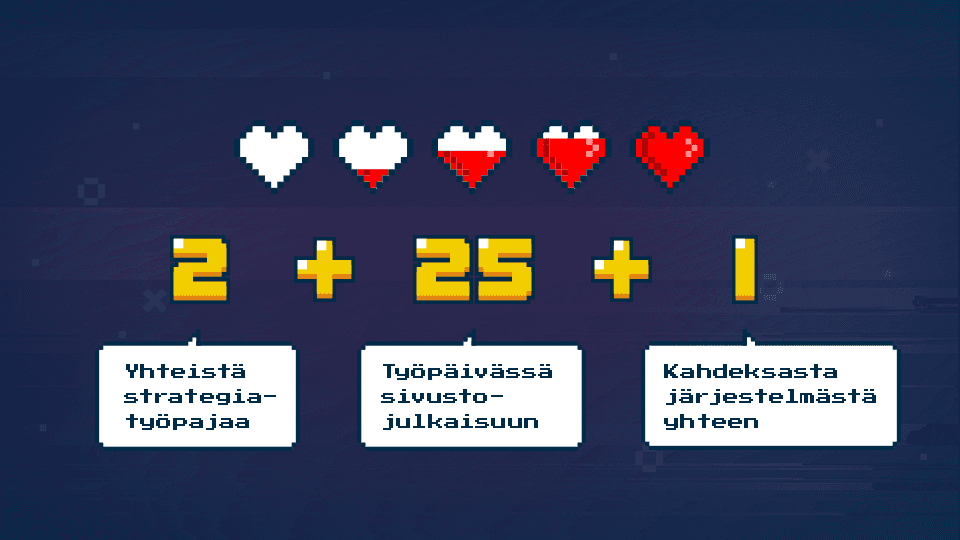
HappySignals decided to consolidate all its activities onto one platform, HubSpot. The final piece of the puzzle is the HubSpot website, launched in October.
Marketing is sales, sales is marketing
HappySignals assists organisations in improving the customer experience and efficiency provided by IT support services. The Employee Experience approach is trendy but fresh. Educational work is a key part of the marketing effort.
The fragmentation of marketing made attracting and nurturing potential customers a challenging guessing game.
- We didn’t know what happened to visitors after they entered or made a purchase decision. What works and what doesn’t, explains HappySignals' Pasi Nikkanen, providing some background.
The new website is the hub of the sales and marketing quality measurement and guidance HubSpot entity.
- What matters is not how many people visit the site, but what leads to a deal.
In an agile project, half the responsibility lies with the buyer
The new happysignals.com was published as soon as it was better than its predecessor. At the time of launch, there were only a few pages.
- It wasn’t complete then, now, nor will it ever be. Perfection would kill our content creation and digital marketing, states Nikkanen regarding his motivating motto.
The time between the kick-off meeting and publication was only one month. The key words for a swift schedule were trust, flexibility, and communication.
- The client had a vision to which we sought solutions. Discussions were not confined to weekly meetings but could be had amid normal everyday life, praises Sami Sundberg, who was responsible for technical design and implementation.
HappySignals did not want to spend time on specifications, but on moving forward and achieving the desired outcome.
- In an agile project, half the success depends on the buyer. One must be proactive and on top of things, or nothing will come of it, Nikkanen reminds.
The digital strategy identified the most important core values
Before the website development, HappySignals and Crasman together formulated a digital strategy that focused specifically on defining the core values important to the business. The main objectives were to speed up the sales cycle and increase the number of leads accepted by sales.
To support the overarching guidelines of the digital strategy, a more operational content strategy was also created. Pasi Nikkanen commends the fruitfulness of the workshops.
- Crasman's strategists were well-prepared, listened to the essentials, read between the lines, and articulated things clearly. This greatly accelerated our own strategy work.
The digital strategy also provided direction for the designers' brainstorming.
- It was important to understand whom we are targeting and what we are aiming for, Sundberg explains the significance of the groundwork.
The site is still fresh, but results are already visible. Its loading speed has increased significantly – something Google values. For the first time, keywords are starting to take effect and organic traffic is growing considerably.
Video content supports purchase decisions online
HappySignals’ sales stem from compelling content. The latest initiative is the Happiness Score Report webinar, published four times a year. Recently, there were over one hundred participants, with a similar number joining the email list. All without paid advertising, using HubSpot's tools.
- We don’t push our product in the webinar but talk about issues, problems, and solutions.
The amount of video content is intended to increase significantly. To provide information that a seller would show a prospective buyer during a demo via Skype.
- The purchasing decision is moving online even on the B2B side. People want to explore the product's suitability themselves and only discuss the final details with the seller, says Nikkanen.
ABM marketing and a personalised website
The next step is transitioning to personalising the site and from inbound to ABM marketing. ABM stands for Account Based Marketing.
In inbound marketing, the company offers interesting content for people to find. In ABM marketing, it hand-picks potential clients it is interested in.
- ABM marketing is essentially smartbound, that is, a customer-tailored mix of outbound and inbound. This underscores the importance of unified data even more, explains Sundberg.
HubSpot CMS tools enable personalising the site by role and campaign: if an ABM campaign is aimed at the financial sector, the homepage is built around financial content, right down to the references offered. It is a feature that would be impossible to implement without HubSpot. At best, personalisation can even be individual-specific.
HappySignals' and Crasman's partnership continues as a strategic alliance covering the development of the site, marketing automation, and paid visibility.
- We tell where we want to go, and Crasman's experts propose solutions. Everything doesn’t have to be figured out by oneself, and that is invaluable, concludes Nikkanen.
Would you like to hear how HubSpot could help grow your business? Get in touch, and let's discuss more!

Anni Laine
People & Culture Manager